Why Is the Northern Cardinal the State Bird in 7 States? ID, Range, and Behavior
Use this profile to confirm Northern Cardinal by structure, sort it from finches and tanagers, set up feeders that match its bill and posture, and understand why seven states chose the same familiar bird.
- Family
- Cardinals
- Diet
- Omnivore
- Status
- LC
- Range cue
- Michigan eBird frequency
Quick Summary
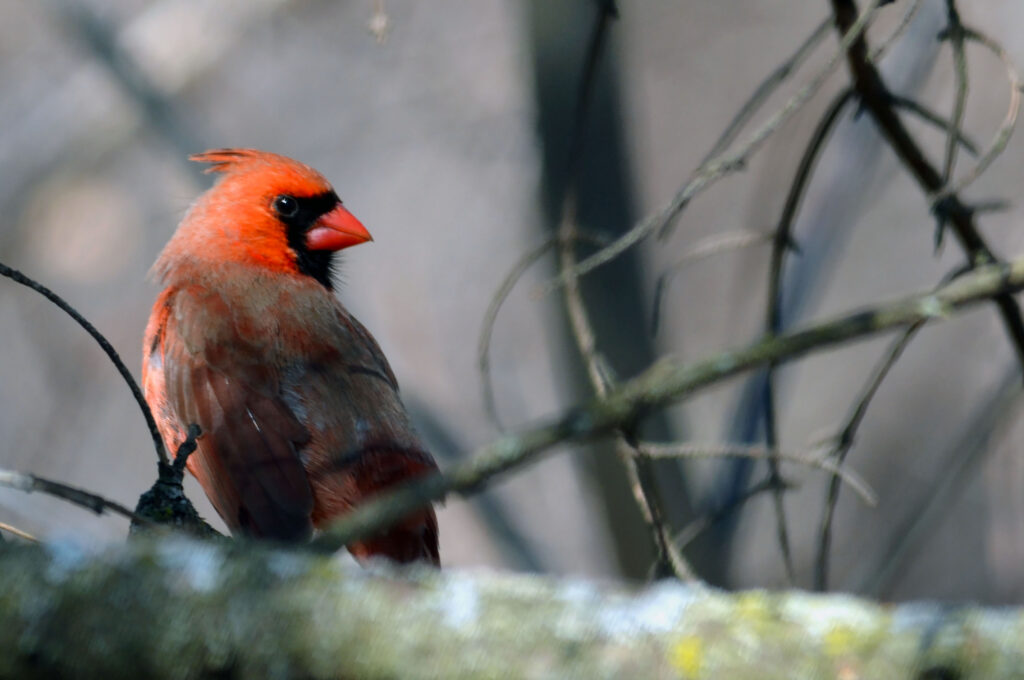
In the bird profiles library, Northern Cardinal is a crested, long-tailed songbird with a thick orange-red bill. Males are bright red with a black face, while females are warm brown with reddish wings, tail, and crest.
01Field marks
Crest, bill, and tail beat red color
Do not start with red alone. Northern Cardinal has a raised crest, a heavy cone-shaped orange-red bill, a long tail, and a strong perched silhouette.
Those marks hold up when the bird is backlit, partly hidden in shrubs, or seen as a brown female instead of a bright male. The head shape and bill often identify the bird before the plumage does.
Male cardinals are the easy version: red body, black face around the bill, high crest, and a tail that looks long when the bird flicks through cover. Females are the test of whether the ID is solid. They are warm brown to buffy, with reddish wings, tail, crest, and bill, so they can disappear into winter brush until the shape and bill color give them away.
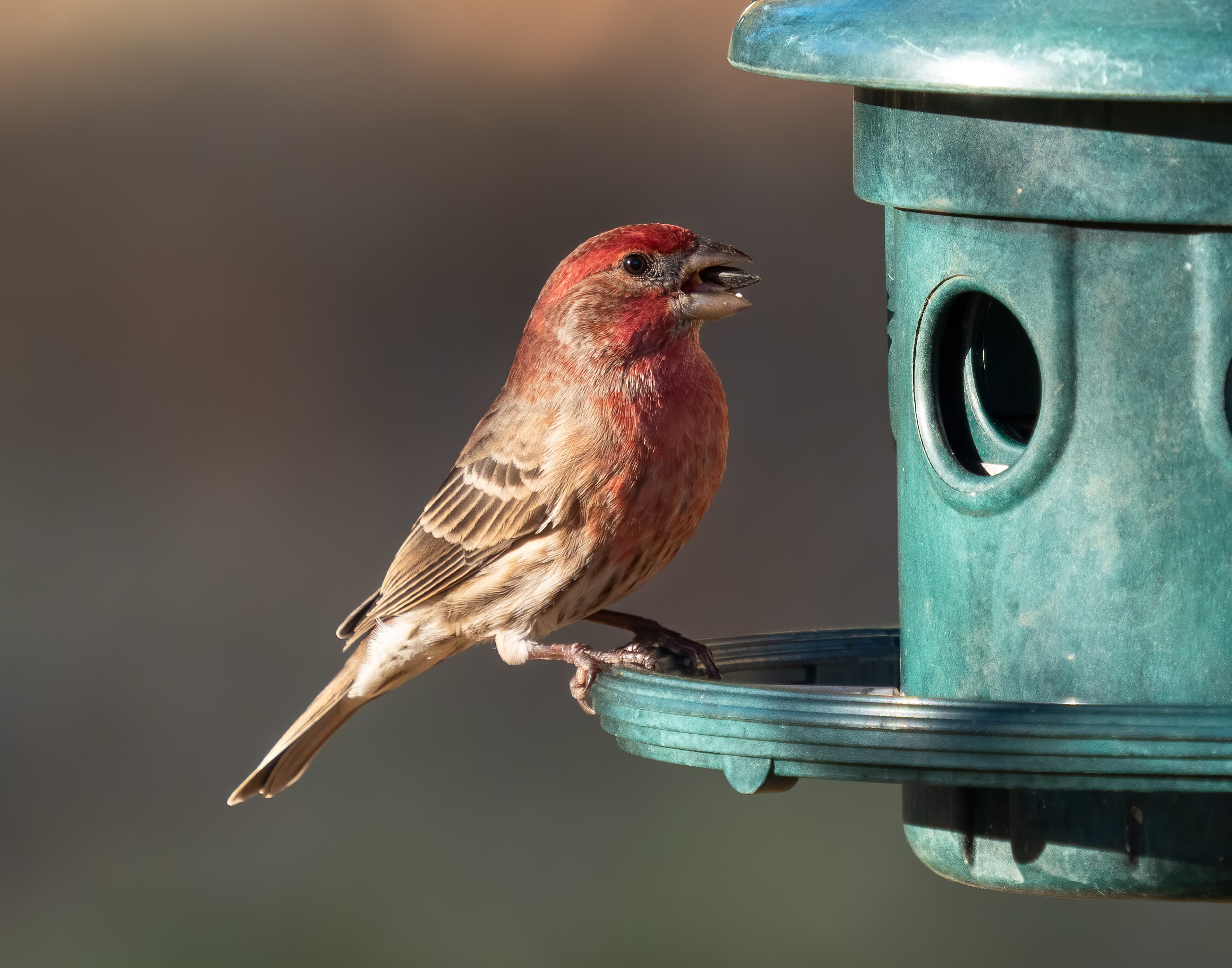
Most red-bird confusion breaks once size and bill shape are checked. Northern Cardinal vs House Finch is usually solved by crest and bill because House Finch is smaller, streakier, and lacks the cardinal head shape. Northern Cardinal vs Purple Finch asks the same structural question before color. Northern Cardinal vs Scarlet Tanager matters in leafy woods, where a tanager can be bright red but has no crest and a different, less feeder-heavy presence.
The cardinals family context helps because this bird is not a red finch. It is a larger, heavier-billed songbird that often moves from shrub to feeder to ground, staying close to cover instead of sitting exposed for long stretches.
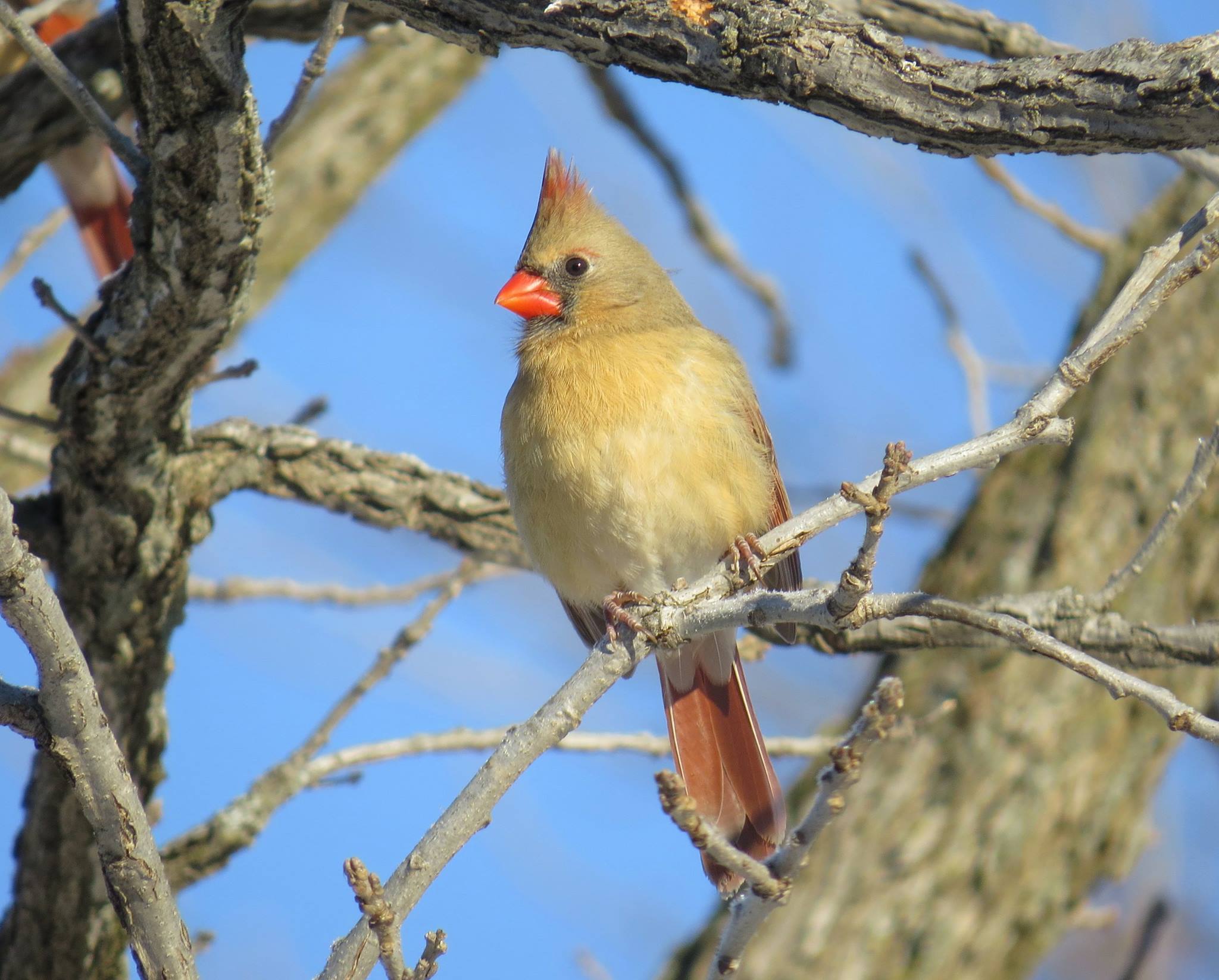
- Shape lock: crest, heavy orange-red bill, and long tail should all agree.
- Male mark: red body plus black face separates adult males from most red feeder birds.
- Female mark: warm brown body with reddish wings, tail, crest, and the same thick bill keeps the ID intact.
Use crest plus bill before judging red color, especially on females and young birds.
06Comparison table
Birds most often confused with Northern Cardinal
| Bird | What differs first | Best clue |
|---|---|---|
| Northern Cardinal vs House Finch | House Finch is smaller, streakier, crestless, and less heavy-billed at feeders. | No crest and streaked body |
| Northern Cardinal vs Purple Finch | Purple Finch lacks the cardinal crest and carries raspberry wash over a smaller finch frame. | Crestless finch shape |
| Northern Cardinal vs Scarlet Tanager | Scarlet Tanager lacks the crest, has dark wings, and favors leafy woodland canopy in season. | Dark wings and no crest |
02Food and foraging
Feeders work when the bird can brace
Feeding success starts with the bill and the perch. Northern Cardinal handles black-oil sunflower, safflower, cracked corn, many weed seeds, and small fruits, but the feeding surface matters almost as much as the food. Cardinals often prefer trays, hoppers, platforms, and open ground because those places let the bird stand, turn, and crack seeds without clinging awkwardly.
That is why a full tube feeder can sit ignored while a tray nearby gets steady visits. The bird is not refusing seed. It is choosing a posture that fits its body. A low platform near shrubs, a hopper with a wide perch, or seed scattered under cover often works better than a narrow perch that favors smaller finches.
Cover is part of the feeding system. Cardinals commonly slip out from hedges, vines, thickets, or evergreen edges, feed for a short stretch, then retreat. The best yard setup for attracting Northern Cardinal combines sunflower or safflower, a stable feeding surface, clean water, and dense shrubs close enough for escape. During breeding season, adults also take insects and soft-bodied prey for young, so a tidy seed station alone does not explain the whole diet.
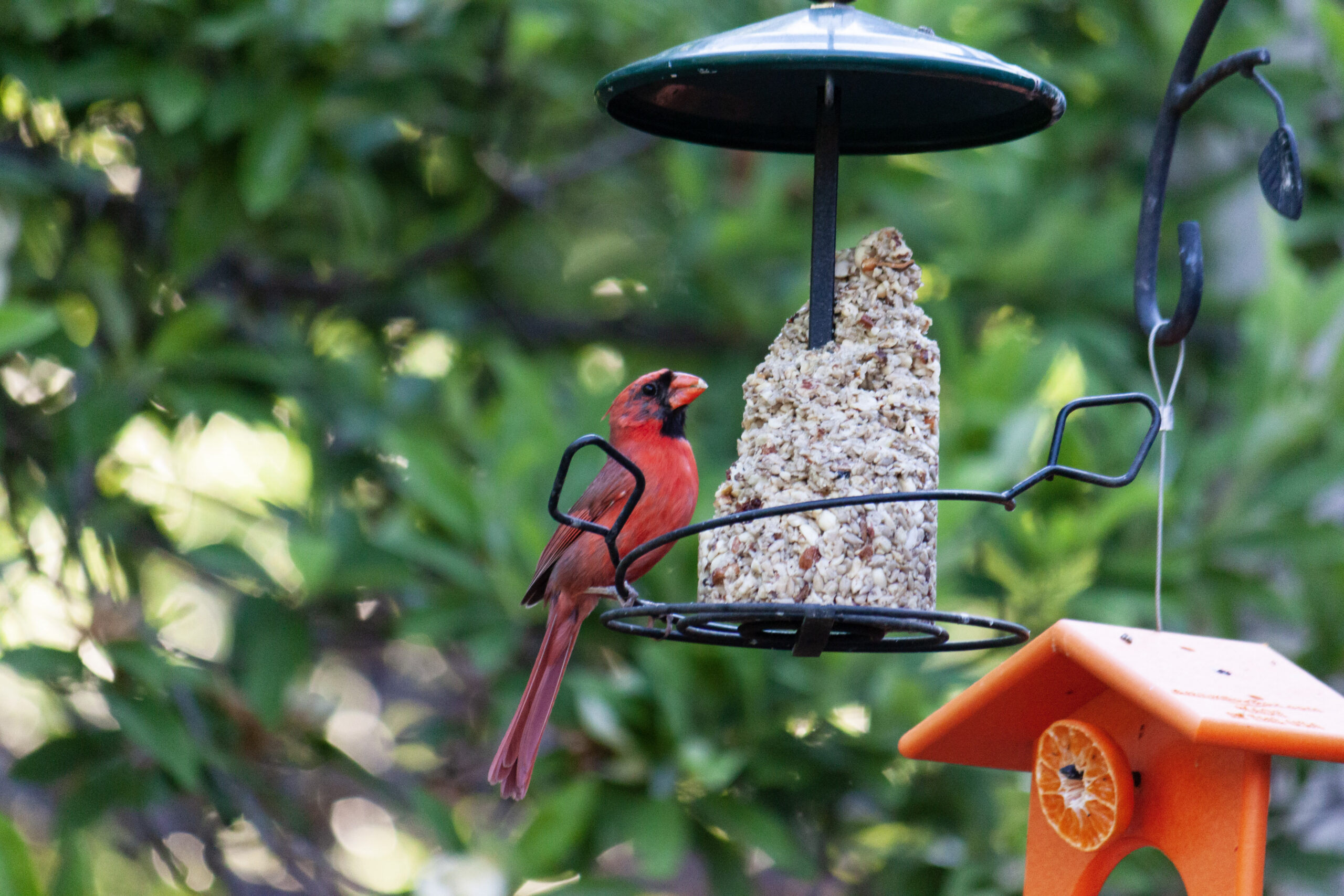
- Best seed: black-oil sunflower and safflower match the crushing bill.
- Best feeder: platform or tray space lets the bird brace its body instead of clinging awkwardly.
- Best cover: shrubs close to food reduce exposure and make cardinals more likely to return.
Wide trays, platform feeders, sunflower, safflower, and nearby shrubs fit cardinal feeding better than narrow tube perches.
03Nesting data
Thick shrubs matter more than nest boxes
Cardinal breeding is tied to cover, not cavities. They do not need nest boxes the way bluebirds or chickadees do. The female builds a cup nest in dense shrubs, vines, small trees, or tangled growth, usually where leaves and stems hide the structure from a casual glance.
Pairs often stay near each other through the year, so spring behavior can build from a familiar local territory. Males sing from exposed perches, feed females during courtship, and keep close to cover while the pair moves through the nesting area. The visible red male may get the attention, but the brown female often controls the actual nest placement.
Multiple nesting attempts are possible when conditions allow, which is why cardinals can seem busy for much of the warm season. A bird carrying fine material into a hedge, a male delivering food, or adults scolding near a vine-covered fence all point to a nest zone even if the nest is hidden.
For yards, the useful lesson is restraint. Dense native shrubs, vine tangles where appropriate, and quiet edges give cardinals more value than a decorative open lawn. Heavy pruning during nesting season can remove the exact cover the species chose.
- Cover need: grape tangles, shrub rows, young trees, and dense vines can hide low nests.
- Pair signal: males often feed females during courtship and nesting.
- Yard clue: repeated trips into one thicket can matter more than a visible nest.
04Behavior and habitat
A resident bird with winter visibility
Winter visibility can make this resident bird feel more dramatic than its status suggests. A cardinal using your hedge in January may be part of the same local pattern you notice in spring. That year-round presence is a major reason the species feels personal to many readers.
The bird still changes social shape through the year. Spring cardinals defend territories and sing often. Both sexes can sing, which separates the species from many backyard expectations where only the male song is noticed. In colder months, territorial pressure loosens and several cardinals may feed near each other around good cover and dependable food.
Habitat explains the pattern better than a simple backyard label. Cardinals use woodland edges, hedgerows, suburban shrubs, streamside tangles, old fields, and gardens with enough dense vegetation. They like edges because edges provide seed, fruit, insects, song perches, nest cover, and escape routes in one small area. That edge habit also explains why the bird can be common without feeling evenly spread.
A cardinal is easiest to trust when crest, bill, tail, feeder posture, and dense cover all point to the same bird.
- Winter pattern: cardinals stay local and often feed in loose groups near cover.
- Song clue: both sexes sing, so a singing brown bird can still be a female cardinal.
- Habitat clue: edges, hedgerows, streamside brush, and planted neighborhoods carry the species.
05Conservation
Why seven states picked the same bird
The conservation story is not about rarity. Northern Cardinal is common and listed as Least Concern, but its cultural durability comes from being easy to see, easy to identify, and present through winter. Bright male color helps, yet the crest, bill, and year-round edge habit do more of the real work.
No other bird has a broader official state-bird footprint. Cardinal appears across seven state-bird designations, including Illinois, Indiana, Kentucky, North Carolina, Ohio, Virginia, and West Virginia. The bird works as a symbol because residents can actually see it around homes, farms, town edges, and parks instead of treating it as a remote emblem.
The state stories differ by place. The Illinois state-bird story leans on a familiar Midwestern yard bird, while the Indiana state-bird story and Kentucky state-bird story connect the same species to edge habitat people recognize close to home.
Local care is still practical. Keep cats away from feeder zones, reduce window collisions near shrubs, clean feeders, and preserve dense cover. The cardinal does not need dramatic rescue language, but it benefits from yards that keep food, water, and shelter close together.
- Status: Northern Cardinal remains listed as Least Concern.
- Local hazards: window strikes, free-roaming cats, and stripped shrub cover still matter around homes.
- Symbol reason: seven states picked a bird residents could see without waiting for migration.
Least Concern. Northern Cardinal is the official state bird in 7 states
What should you check or read next?
A final check on Northern Cardinal separates look-alike comparisons, related bird profiles, and practical next steps.
Questions and answers
Why is the Northern Cardinal the state bird in so many states?
It is bright, familiar, easy to identify, and present year-round. Seven states chose a bird residents could recognize in yards, parks, and winter cover.
How do I tell a female Northern Cardinal from a House Finch?
Look for the crest, heavy orange-red bill, long tail, and warmer reddish wings and tail. House Finches are smaller, streakier, and crestless.
Do Northern Cardinals migrate?
Northern Cardinals are mostly non-migratory. They may shift into thicker cover during harsh weather, but they usually remain near the same local area.
What food brings Northern Cardinals to feeders?
Black-oil sunflower and safflower are the strongest choices. Use a platform, tray, or hopper ledge near shrubs instead of relying only on narrow tube perches.
Where next?
Use the strongest adjacent guides to keep moving with the same bird, the family, or the wider state-bird shelf.