Montana State Bird

Quick Answer
The state bird of Montana is the Western Meadowlark (Sturnella neglecta), designated in 1931.
Quick Facts
- State
- Montana
- Designated
- 1931
- Family
- Blackbirds
- Length
- 24 cm
- IUCN
- Least Concern
The Montana state bird is the Western Meadowlark, a grassland bird that fits the state's open plains and ranch country better than a forest emblem would. In the state birds collection, Montana's meaning comes from distance, with a small yellow-breasted singer holding a fence post against a huge horizon.
This page should not copy the Kansas prairie story. Montana's meadowlark belongs to sage-edged grassland, foothill pasture, and eastern plains where roads, cattle fences, and native grass create the perches and cover the bird uses.
01State symbol
Why Montana chose the Western Meadowlark
Montana designated the Western Meadowlark in 1931, earlier than several other meadowlark states. The choice gave Montana a bird that ordinary residents could meet along ranch roads and open fields, not only inside protected preserves.
The state-symbol fit is strongest east of the mountains, where the land opens and the bird's singing perch becomes part of the view. The meadowlark is small, but it marks space in a way that matches Montana's plains.
That plains emphasis separates Montana from Oregon's meadowlark, where the same species has to carry a western lowland and dry-country story across a different map.
02The bird
About the Western Meadowlark
Western Meadowlarks look built for open ground. The yellow underparts and black chest V flash when the bird faces you, while the streaked brown back disappears quickly once it drops into grass.
In Montana, this behavior matters. A bird may be obvious on a post for a few seconds, then vanish into cover that looked too short to hide anything.
Meadowlarks eat insects and seeds and nest on the ground. That links the state bird to grazing patterns, hayfield timing, native grass patches, and open-country edges with working-land stories.
03Where to look
Where to see the Western Meadowlark in Montana
CM Russell National Wildlife Refuge gives Montana readers a strong eastern-plains setting, with grassland, breaks, and open roads where meadowlarks can perch in view. Makoshika State Park adds badlands edges and sparse grass that still suit the species.
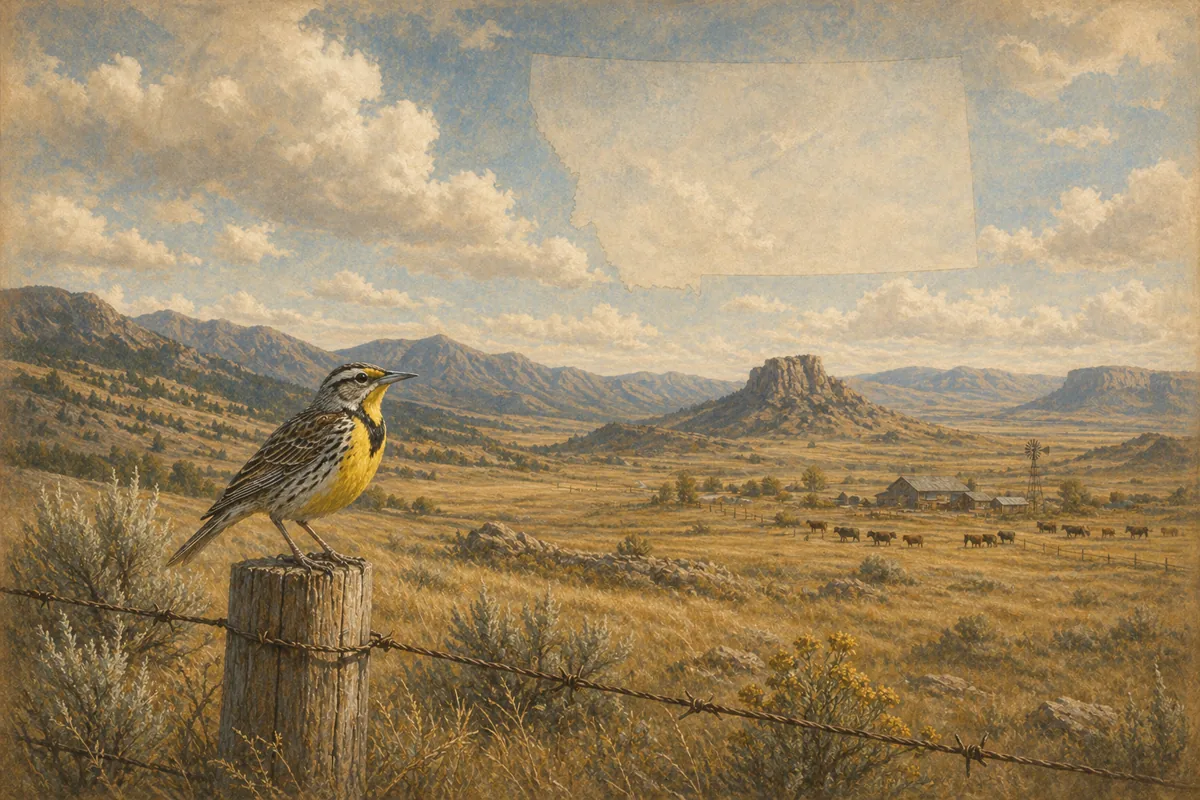
The Bison Range offers a different scan along fence lines and open slopes, especially in spring and early summer. Those searches overlap with Wyoming's meadowlark, but Montana's page should keep the reader focused on ranch-country scale and eastern-plains visibility.
04Conservation
Conservation of the Western Meadowlark
IUCN lists the Western Meadowlark as LC, but Montana should still treat grassland quality as the main reader takeaway. Ground nests are vulnerable when fields lose cover or get disturbed at the wrong point in the breeding season.
That is the difference between this page and Kansas's meadowlark page. Montana centers open range, sage-grass edges, and the scale of plains habitat.
Least Concern. Western Meadowlark remains the official state bird of Montana.
Where should you go next?
Continue with nearby state birds, the wider location layer for Montana, or the full species profile for the Western Meadowlark.


Questions and answers
What is the Montana state bird?
The Montana state bird is the Western Meadowlark, officially designated in 1931.
Why is the Western Meadowlark the Montana state bird?
Montana chose the Western Meadowlark because it fits open plains, ranch country, and grassland edges that define much of the state.
Where can I see a Western Meadowlark in Montana?
Look along fence lines, ranch roads, and grassland edges at Charles M. Russell National Wildlife Refuge, Makoshika, and the Bison Range.
Continue exploring
The strongest next reads stay with the state collection, the location layer, or the bird itself.