Virginia State Bird

Quick Answer
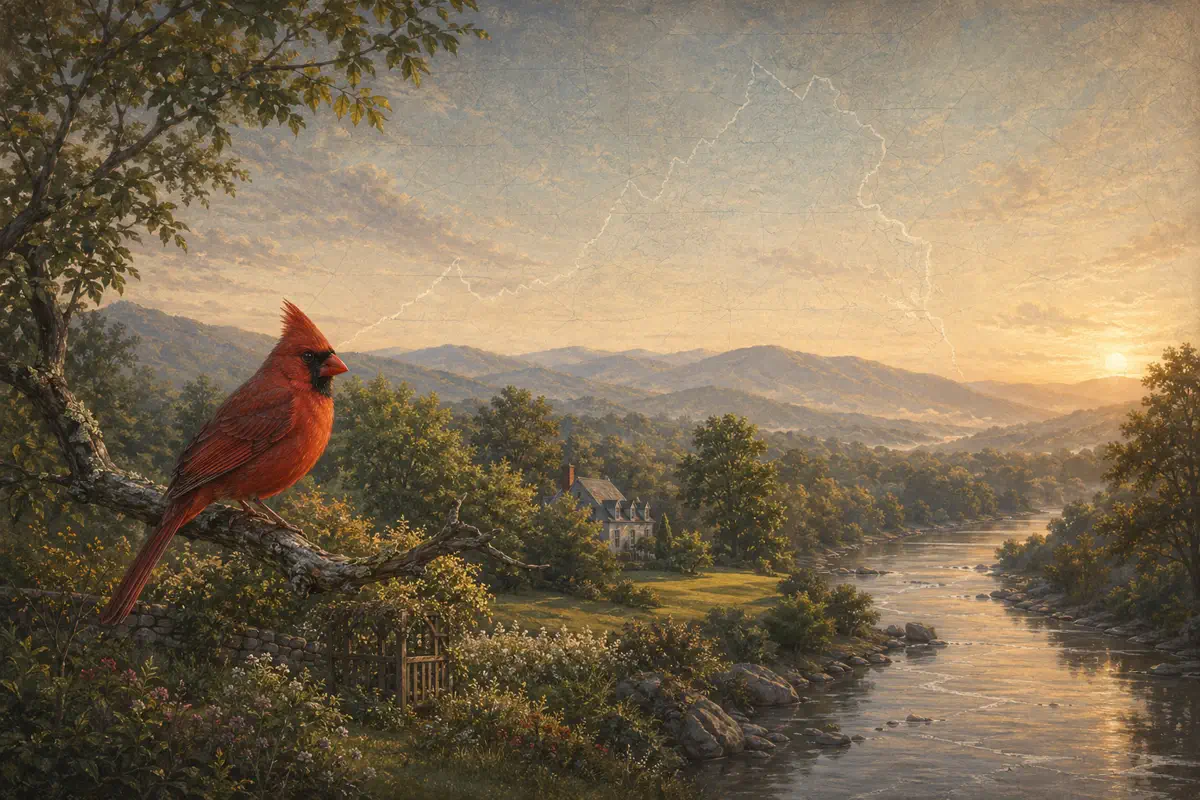
The state bird of Virginia is the Northern Cardinal (Cardinalis cardinalis), designated in 1950.
Quick Facts
- State
- Virginia
- Designated
- 1950
- Family
- Cardinals
- Length
- 22 cm
- IUCN
- Least Concern
The Virginia state bird is the Northern Cardinal, and the fit comes from how well the bird crosses Virginia's regions. It shows up in Tidewater yards, Piedmont hedgerows, Blue Ridge edges, and suburban greenspace, so the official symbol also belongs naturally in the broader state birds collection.
Virginia's angle is breadth. This page should answer the state-symbol question first, then show why a cover-loving backyard bird can represent a state that runs from coastal marsh to mountain forest.
01State symbol
Why Virginia chose the Northern Cardinal
Virginia designated the Northern Cardinal in 1950, choosing a bird with color, familiarity, and a strong year-round presence. The choice works because cardinals remain visible when many flashier migrants have moved on, so the symbol does not disappear outside spring.
The bird also carries a strong public identity. A male cardinal on a bare branch gives Virginia a clear emblem, while North Carolina's cardinal leans into a different coastal-to-Piedmont mix than Virginia's Blue Ridge and Tidewater spread.
02The bird
About the Northern Cardinal
Virginia cardinals are edge birds. They sit where woods meet yards, where streamside shrubs meet lawns, and where vines or young trees give quick cover.
The Northern Cardinal has a thick orange-red bill, a peaked crest, and a long tail. Males are red, while females are brown with red highlights and the same strong shape.
They eat seeds, insects, and fruit, then nest in dense shrubs or tangles rather than high canopy. That habit explains why a cardinal may be common beside a Richmond garden path, a Shenandoah trailhead, or a brushy edge near the James River.
03Where to look
Where to see the Northern Cardinal in Virginia
In Virginia, look where cover and open viewing space meet. Shenandoah National Park is useful around trailheads, camp edges, and lower-elevation thickets, while the James River Park System puts cardinals close to city river corridors.
Chincoteague National Wildlife Refuge gives the page a coastal contrast. Skip the open beach and check wooded edges, shrubs near roads, and sheltered cover where the same species that represents inland Virginia also appears near the coast.
The easiest views often come from ordinary feeders and hedge lines, the same everyday access that explains why Illinois's state bird also works as a public symbol.
04Conservation
Conservation of the Northern Cardinal
IUCN lists the Northern Cardinal as LC. For Virginia readers, the practical issue is not statewide scarcity but the quality of local cover.
Cardinals benefit when gardens, parks, and stream corridors keep native shrubs, seed-bearing plants, and low nesting cover. That makes Virginia different from West Virginia's cardinal page, where the same bird is read through mountain hollows and wooded towns.
Least Concern. Northern Cardinal remains the official state bird of Virginia.
Where should you go next?
Continue with nearby state birds, the wider location layer for Virginia, or the full species profile for the Northern Cardinal.


Questions and answers
What is the Virginia state bird?
The Virginia state bird is the Northern Cardinal, officially designated in 1950.
Why is the Northern Cardinal the Virginia state bird?
Virginia chose the Northern Cardinal because it is colorful, familiar, present year-round, and easy to recognize across much of the state.
Where can I see a Northern Cardinal in Virginia?
Search wooded edges, yards, and river corridors at Shenandoah National Park, Chincoteague, the James River Park System, and neighborhood feeders.
Continue exploring
The strongest next reads stay with the state collection, the location layer, or the bird itself.